
Fulton Projected and Actual Dates
A projected date answers what may happen under current information. An actual release date records what did happen. At the Corrections Center of Northwest Ohio, the active roster may show an “Estimated Out Date” for a current booking. It can be blank. It is not the timestamp from the release sheet, and it can change after a new court order, credit correction, warrant, hold, or case event.
The Ohio Department of Rehabilitation and Correction uses “Expected Release Date/Parole Eligibility Date.” Its combined wording matters. For one sentence, the value may reflect an expected end under the agency's computation. For another, it can mark the first date a parole decision is legally possible. Eligibility does not promise that the person will leave prison on that date.
A person held before trial often has no fixed release date. Bond may permit release, but processing, a court decision, and every other hold must be resolved. A bond posting or estimated field is therefore a lead, not proof that the booking ended.
Two Fulton Release Date Labels
Fulton cases can move through a regional jail and then into a statewide prison system. That creates two official-looking date labels with different legal force. The CCNO active population report attaches Estimated Out Date to an active jail booking. The ODRC Offender Search uses Expected Release Date/Parole Eligibility Date on a state record.
| Label | System | What it can mean | What it cannot prove |
|---|---|---|---|
| Estimated Out Date | CCNO active roster | A jail-side estimate for an active booking | The actual date and time custody ended |
| Expected Release Date/Parole Eligibility Date | ODRC person record | A computed state date or eligibility point, based on sentence type | A guaranteed prison departure |
| Actual release date/time | CCNO or ODRC release record | The completed custody event held by that agency | The end of all later supervision |
Do not carry the CCNO estimate into an ODRC case as if the two agencies share one clock. A Fulton Common Pleas prison sentence can result in a conveyance from CCNO to ODRC. The person has left CCNO but remains incarcerated. The court conveyance entry and CCNO transfer record form the bridge to the new custodian.
The official ODRC result example below shows why the person-level record, status, and footnotes must be read together. View the approved public ODRC example source.
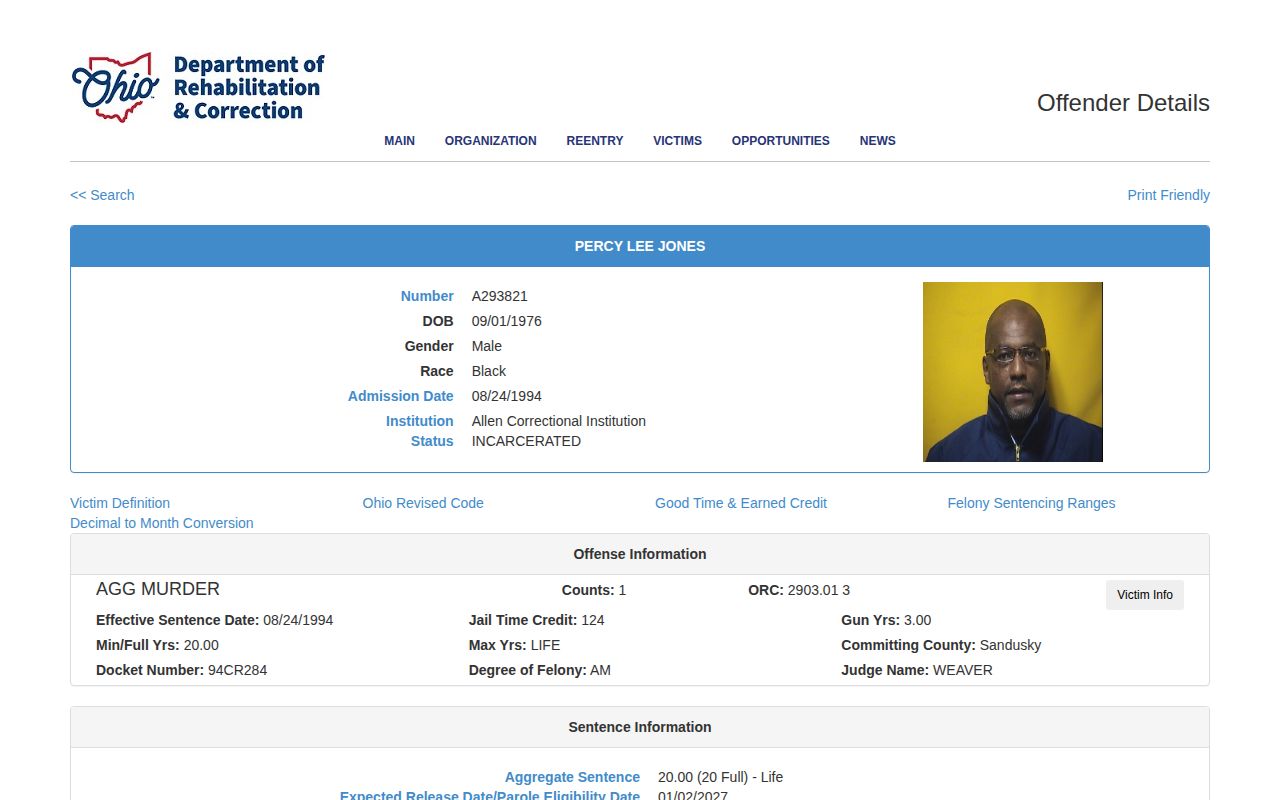
The screenshot demonstrates the state record layout. It does not establish a date for another person.
Find a Fulton Release Date
The correct route depends on the sentence and custodian. Begin with the signed court record rather than applying a formula to a sentence announced elsewhere. Fulton Common Pleas handles felonies, while Eastern and Western District Courts handle local misdemeanor cases within their jurisdictions.
- Identify current custody. Search CCNO's timestamped active population for a local booking. If the person is active, read any Estimated Out Date only as a current estimate.
- Read the court entry. Find the imposed term, start point, jail-time credit, concurrent or consecutive terms, bond terms, and any conveyance order.
- Use CCNO for a local term. Call 419-428-3800 and ask about the current calculation and any holds. A clerk or records custodian can explain which existing record contains the date.
- Use ODRC for a prison term. Search by offender number when possible, or match the name with sentencing county, case, status, and offense rows.
- Read the exact state label. Compare status with Expected Release Date/Parole Eligibility Date, POA/PRD Date, and parole-hearing information.
- Confirm the completed event. Request the actual CCNO release entry or ODRC release/discharge record after the date passes.
POA means “parole on or after.” PRD means “Projected Release Date.” A Supervision Start Date plus an APA Offices field is stronger evidence that a state prisoner departed to supervision. It still does not show that the person reached final discharge.
Note: An absent name does not prove release because a transfer, data update, new custodian, or restricted record can explain the result.
Ohio Credit for Fulton Dates
Ohio Revised Code 2967.194 governs current earned credit for qualifying confinement on and after April 4, 2024. Eligible people may provisionally earn one or five days for a completed month of productive participation. A second qualifying activity can support more credit under the statute. Completion awards may be ninety days or ten percent of the stated term, whichever is less.
Ordinary aggregate credit is generally capped at fifteen percent, but that figure is not a universal release formula. The law has separate completion awards, excluded sentences, conduct review, withdrawal, and finalization rules. Current implementing detail appears in Ohio Administrative Code 5120-2-06. Earlier qualifying confinement can involve former-period ORC 2967.193.
The common “serve about eighty-five percent” shorthand leaves out too much. It can obscure mandatory or non-reducible time, program awards, jail-time credit, consecutive terms, indefinite terms, judicial release, court corrections, and discipline. Current law also excludes listed sentence categories. The date shown by ODRC is the agency's computation. Do not replace it with home arithmetic.
ORC 2967.191 addresses qualifying confinement credit while awaiting trial or commitment. That credit begins with the court and agency record. It is not the same as earned credit for program participation.
Fulton Sentence Rules Change Dates
Ohio sentence type determines how a date must be read. A definite prison term can produce a computed expected end, subject to lawful changes. A qualifying indefinite term under the Reagan Tokes framework has a minimum and maximum. ORC 2967.271 creates a rebuttable presumption of release at the minimum in covered cases, but the statutory process can maintain incarceration up to the maximum.
Judicial release is different from earned credit. Under ORC 2929.20, the sentencing court considers a defined early-release mechanism, subject to eligibility rules and exclusions. Parole eligibility for covered older, indefinite, or life terms is addressed in ORC 2967.13 and depends on the sentence. The judgment and law effective for that case control.
- Projected release
- A future date calculated from current records and rules.
- Parole eligibility
- The point when a covered person may be considered, not a promised release.
- Judicial release
- An early-release action ordered by the sentencing court under Ohio law.
- Jail-time credit
- Qualifying prior confinement credited toward the sentence.
- Detainer
- A request or authority that can keep or transfer a person for another matter.
Why Fulton Release Dates Change
A projected date is only as stable as the facts behind it. Some changes reduce time. Others extend custody or change where the person goes. The current custodian must reconcile the case before the actual exit.
| Factor | Possible effect | Record to check |
|---|---|---|
| Jail-time credit correction | Moves the computed date | Sentencing entry and agency calculation |
| Earned credit or withdrawal | May reduce time or restore days | ODRC computation and conduct record |
| New warrant or detainer | Can block a community release or cause transfer | Court docket, hold, and disposition record |
| Amended court order | Changes the legal basis or term | Signed journal entry |
| Parole decision | May set, continue, deny, or rescind a release path | ODRC details and official Board minutes |
| Indefinite-term process | May keep custody beyond the minimum | ODRC record and ORC 2967.271 process |
Another hold is especially important at CCNO. The regional jail houses Fulton commitments and can also hold people for other counties or federal authorities. Leaving one booking does not always mean returning to the community. The actual release or transfer disposition should name the next authority.
Parole Board information requires the same care. ODRC lets a reader search by the next hearing or review month and may show the latest type and result on the person record. A review month is not a fixed release day. Labels such as continued hearing, transitional control recommended, or recommended pending judge describe different steps, and even “paroled” can come before release planning and the physical exit.
Ohio Administrative Code 5120:1-1-11 requires hearing decisions to be recorded in official minutes. Rule 5120:1-1-10 permits a projected release date within the Board framework but states that it remains subject to rescission. When a displayed result could change the expected date, request the applicable public minute or order, then confirm the later ODRC status and release detail. The decision record explains authority; the completed release record proves when custody ended.
Fulton Jail Date Calculation
For a local jail term, begin with the signed sentencing entry. Note the imposed days, when the term starts, whether terms run together or one after another, and the credited confinement. Then ask CCNO for its current calculation and all holds. The state-prison earned-credit statute should not be applied automatically to a CCNO sentence.
CCNO's public records route can supply the final record. Ask for the booking-and-release sheet or jail-register entry tied to one booking, including the actual release date and time, release authority, type, and destination to the extent those existing fields are public. Ohio law allows lawful redactions and does not require an office to create a new calculation.
For a full person search across CCNO, court, and state systems, use the Fulton County release-record path. It keeps local jail release separate from transfer into ODRC, federal custody, another jail, or immigration detention.
Confirm Fulton Actual Release Dates
Once the projected day arrives, recheck status. At CCNO, request the completed release entry. For ODRC, inspect current status, Parole or Release Detail, and any supervision start. If the public result remains unclear, write to Ohio Department of Rehabilitation and Correction, Attn: Central Records, P.O. Box 430, Columbus, OH 43216, with the name, ODRC number, and date range.
Ohio VINE can send an alert for enabled events while a person is in custody, but it is a notification layer. A VINE release message can lag and does not replace the custodian's record. The Fulton VINE inmate check explains the specific-person registration and confirmation path.
Keep each milestone distinct: the court authorizes, the jail or prison executes the physical release, and a supervision agency may later issue final discharge. One date rarely proves all three events.
Public Record Search
Sponsored Results