
Ohio Prison Release Route
The Ohio Department of Rehabilitation and Correction operates adult state prisons across Ohio. A Fulton Common Pleas prison sentence begins the state path even though the county has no ODRC institution. CCNO transports sentenced people for reception and classification, after which ODRC assigns an institution. Physical departure from CCNO does not mean the person is free. It means custody has shifted from the regional jail to the state.
A later ODRC departure can have several legal forms. Parole is discretionary release under eligible sentence structures. Post-release control is a statutory term of state supervision after certain prison sentences. Transitional control is a structured move toward community placement. Judicial release comes from the sentencing court. Final discharge ends the applicable state custody or supervision obligation. Those labels are not interchangeable.
| Event | Custody meaning | Best record |
|---|---|---|
| CCNO to ODRC | Still incarcerated | Fulton court conveyance, CCNO transfer, ODRC admission |
| ODRC institutional release | Out of prison, perhaps under APA supervision | ODRC status, release detail, supervision start |
| Judicial release | Court-authorized prison departure under Ohio law | Sentencing-court entry and ODRC status |
| Final discharge | State supervision or legal custody has ended | ODRC final-release or discharge record |
Note: Release from an institution and final discharge from state supervision can occur on different dates.
Search Ohio Prison Releases
The ODRC Offender Search is the main public route. Use an offender number when known because it is more precise than a name. Enter an A, R, or W prefix without a hyphen. Name searches can return longer surnames beginning with the same letters, so compare identifiers, date data, sentencing county, case, offenses, and the ODRC number before accepting a match.
- Search by offender number or name. If needed, choose Fulton as County of Commitment, which means the sentencing county.
- Open the individual record and read the current status before reading any date.
- Compare institution, APA supervision, Judicial Release, Released, or Violator at Large wording with the Fulton case.
- Read the Parole or Release Detail, supervision start, APA office, and sentence rows in context.
- Ask ODRC Central Records for the public release, parole, or final-discharge record when the web result is absent or ambiguous.
Residential County and ZIP are different filters. They apply to APA Supervision or Violators at Large and reflect last-recorded information. They are not a verified present address. A person sentenced in Fulton can live elsewhere after release, while a person sentenced in another county might later have Fulton listed as a residential county. The filter must match the question being asked.
Ohio Release Record Fields
An ODRC person record may display a photo, aliases, ODRC number, institution or supervision status, offenses, sentencing county and case, admission date, stated term, parole-hearing information, and an “Expected Release Date/Parole Eligibility Date.” The combined label is deliberate. Depending on sentence type, it may be an expected computation or the first point at which parole can be considered. It is not proof that the person actually left on that day.
| ODRC field | How to read it |
|---|---|
| Status | Start here: Incarcerated, Released, APA Supervision, Violator at Large, or another stated posture |
| County of Commitment | The sentencing county, not residence |
| Expected Release Date/Parole Eligibility Date | A future computation or eligibility point, not an actual exit timestamp |
| Supervision Start Date | Strong evidence of departure from prison into APA supervision |
| APA Offices | The live field identifying the responsible supervision unit |
| Latest Hearing Result | A decision-stage label that may precede physical release |
The ODRC status definitions distinguish these categories. A Violator at Large entry means the person earlier entered supervision and is alleged to have absconded. It does not prove current custody. Judicial Release reflects a sentencing-court mechanism. Physical release and final legal discharge remain separate milestones.
The official ODRC example record shown below demonstrates the kind of detail page used to assess a release. It is a public agency example, not a model for guessing another person's status.
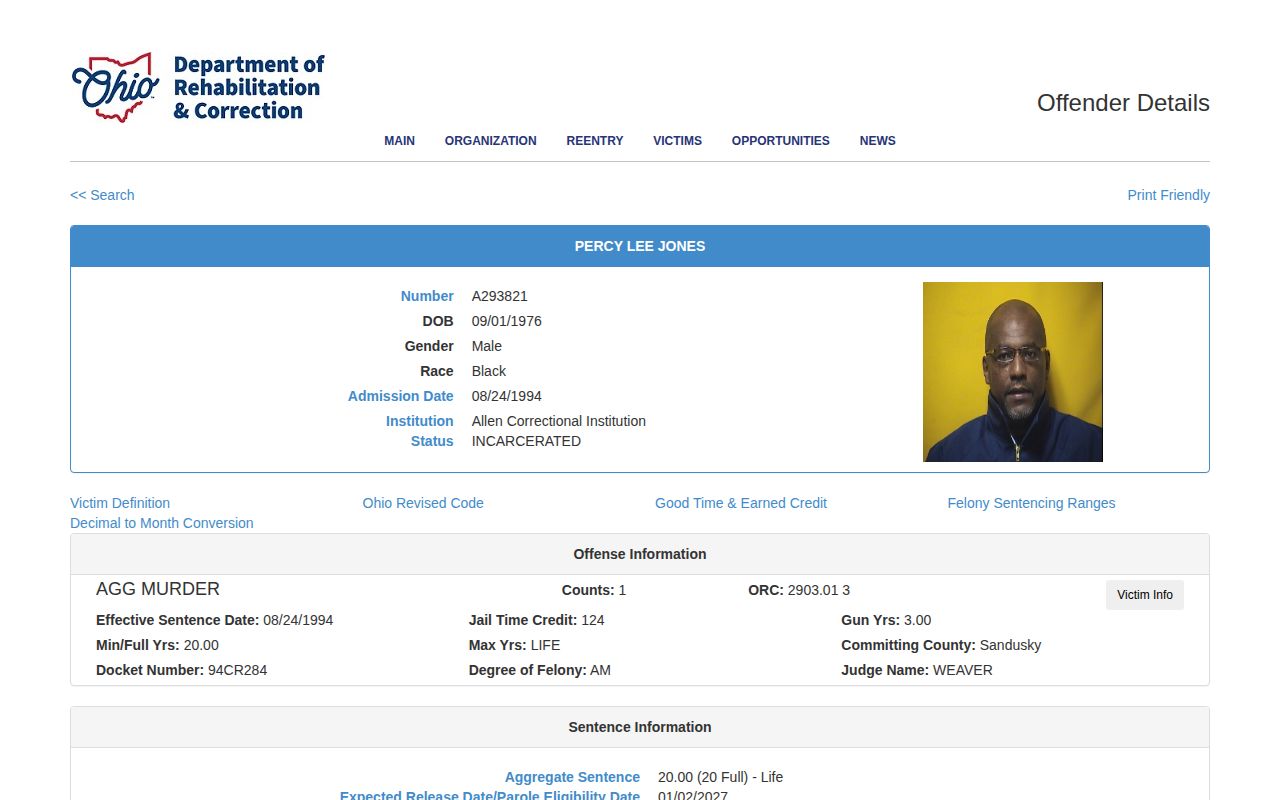
The screen supports field interpretation, but a current search and a records request are needed for a different person or a later status change.
Ohio Prison Release Records
For durable confirmation, write to Ohio Department of Rehabilitation and Correction, Attn: Central Records, P.O. Box 430, Columbus, OH 43216. Identify the ODRC number, full name, and a focused date range. Ask for the public release, parole, judicial-release, or final-discharge documentation that answers the event in question. ODRC does not promise that every fully discharged historical person will remain in the public search forever.
Ohio Department of Rehabilitation and Correction
Attn: Central Records
P.O. Box 430
Columbus, OH 43216
Use the current ODRC contact directory and person-detail instructions for record issues.
Ohio's public search does not open an entire prison file. ORC 5120.21 and corrections rules protect parts of inmate records. Parole and post-release-control proceedings also have public-record limits. Request a precise existing record and expect lawful redactions. If the event began in Fulton, the Common Pleas sentencing or judicial-release entry is a separate court record and must be requested from that court.
ODRC records should not be used to document a person who only served a local CCNO sentence. Such a person may never enter the state system. The CCNO release record and Fulton court docket are the right sources in that case.
Ohio Prison Release Dates
Several events can change a projected date: sentence aggregation, consecutive terms, court corrections, jail-time credit, detainers, earned credit, disciplinary decisions, parole action, and Ohio's indefinite-sentence rules. Current earned credit under ORC 2967.194 is conditional. Some sentence categories are excluded. Monthly credit depends on documented participation and conduct review, and credit can be denied or withdrawn.
The common “85 percent” shortcut is not a reliable calculation. It can overlook mandatory or non-reducible time, program-completion awards, judicial release, jail-time credit, multiple terms, and sentence type. ODRC's computed date should be read as the agency's current field, not replaced with home arithmetic. The dedicated Release Date Lookup explains these Fulton and state date labels in more depth.
A parole hearing result can also precede release planning and physical exit. Terms such as continued hearing, full board, transitional-control recommendation, or recommended pending judge describe different processes. Even a favorable result should be followed by the later status, release detail, supervision start, and Central Records document.
Fulton Prison Transfer Property
The transfer from CCNO to ODRC has its own property rules. CCNO's prison-transfer instructions say unauthorized property is not transported to state reception. A person arriving for a walk-in prison commitment is directed to release money and belongings to family or a friend immediately. This practical step marks a transfer into prison, not a return to the community.
If property remains at CCNO during the conveyance, the Property Master may contact family or a friend. CCNO says unclaimed property can be disposed of after 60 days, prescription medication not collected within 30 days is destroyed, and certain returned or unforwardable funds are held for two years before transfer to the inmate trust fund. These periods apply to the prison-transfer context and not to every jail departure.
Use the CCNO prison-transfer page for the current instructions and contact the regional jail about a specific property record. Once ODRC accepts the person, later institutional property and release procedures belong to the assigned state facility. The transfer paperwork provides the bridge between the two custodians.
After Ohio Prison Release
A status of APA Supervision indicates that the person is out of the prison institution but remains under the Adult Parole Authority. The detail record can show a supervision start date, period, conditions, and APA office. ODRC warns that a supervision period may stem from an earlier offense rather than the newest sentence row. Read the entire record before tying the obligation to one Fulton case.
ODRC's published conditions say a releasee must report in person to the supervising officer by the next business day. The live APA Offices field is therefore the correct source for the responsible unit. Do not assume a fixed northwest Ohio office based only on geography. Final release or early termination is stronger evidence that state supervision ended than a past prison release date alone.
- Parole
- Conditional prison release granted under an eligible sentence structure.
- Post-release control
- A statutory supervision term after certain prison sentences.
- Final discharge
- The end of the applicable ODRC custody or supervision obligation.
- Detainer
- A request or authority that may lead to custody by another agency.
A search that begins with a local Fulton booking can use the Fulton County release-record path to establish the CCNO event before following a documented prison transfer into ODRC.