
Where CCNO Releases Go
The Corrections Center of Northwest Ohio, often called CCNO, is the regional jail that houses many people committed by the Fulton County Sheriff and Fulton courts. Leaving its active population can mean several things. A person may leave for the community after bond, recognizance, dismissal, time served, completion of a local jail term, or another court order. CCNO may instead convey a person sentenced by Fulton Common Pleas to the Ohio Department of Rehabilitation and Correction. Another holder can cause a transfer to a different jail. CCNO also holds federal populations, so an exit may lead to U.S. Marshals or immigration custody.
The actual booking-and-release entry should identify the release authority, time, type, or destination to the extent those fields exist and are public. Pair that record with the signed court order. A current roster only answers whether CCNO regarded someone as active at its timestamp. It cannot say why a name later vanished. The broader Fulton County released-inmate search and release-record process is covered on the home page.
| CCNO outcome | What it means | Next confirmation |
|---|---|---|
| Community release | Physical custody ends under bond, sentence completion, dismissal, or court authority | CCNO release entry and Fulton court docket |
| ODRC conveyance | The person leaves the regional jail but remains incarcerated | CCNO transfer record, court entry, then ODRC Offender Search |
| Other holder | Another county or agency takes custody | Destination in the release record and receiving agency |
| Federal or ICE handoff | CCNO custody ends while another form of detention starts | Release disposition plus the correct federal locator |
Note: A roster disappearance is a lead, not proof that a person returned to the community.
Confirm a CCNO Release
Begin with CCNO because it is the jail operator. The active offender population covers all participating jurisdictions, not Fulton alone. Match the booking number, committing or arresting agency, court, and case rather than relying on name alone. The report can show an Estimated Out Date, but that date is prospective. Previous Day Bookings and Previous 7 Days Bookings are intake products. Neither is a release list, and neither supplies an actual release reason.
- Search the CCNO active population. Record the report timestamp and match Fulton agency or court information.
- If the person is absent, use the historical booking search or booking reports to locate the correct booking number. Do not label the absence a release.
- Read the correct Fulton court docket and signed bond, dismissal, sentencing, conveyance, or release entry. Court posting can lag.
- Request the named booking's actual CCNO booking-and-release sheet or jail-register entry.
- Follow a stated destination into ODRC, another jail, BOP, USMS, or ICE. Check supervision separately after physical release.
The historical CCNO Victim Notification search accepts first name, last name, booking or inmate number, and booking-date bounds. It can help distinguish repeated admissions and recover a booking number after the active entry is gone. Research did not establish that its result provides the exact release time or type. It is therefore a booking-identification channel, not a released-inmate database.
CCNO Release Records Contact
Ask CCNO for an existing record tied to one booking. Useful identifiers include the full name, aliases, date of birth when known, booking number, admitting agency, and a narrow date range. Request the actual release date and time, release authority, destination or disposition, and release type only to the extent those fields exist. An office does not have to create a report or answer research questions when no such record exists.
Corrections Center of Northwest Ohio
03151 County Road 2425
Stryker, OH 43557
Phone: 419-428-3800, extension 201
Fax: 419-428-2119
Email: ccnoregional@gmail.com
Published business contact hours: Monday through Friday, 8 a.m. to 4 p.m.
The official CCNO Public Records Request page permits requests by email, mail, telephone, or in person. It lists single-sided letter-size paper copies at $0.25 per page and says records are provided at cost within a reasonable time. Ask for an electronic copy and a cost estimate. Medical records, protected investigative material, Social Security numbers, safety-sensitive information, and records barred by law may be withheld or redacted. If part of a record is withheld, ask for the separable public portion and the legal basis for each redaction.
Fulton Releases Use Regional Jail
Fulton County does not run the standalone online county jail that a generic search may suggest. CCNO is a multicounty full-service adult jail operated through the Corrections Commission of Northwest Ohio. Its official materials identify Defiance, Fulton, Henry, Lucas, and Williams as member jurisdictions and also describe federal contract beds. The building is in Stryker. A person arrested by the Fulton County Sheriff or a municipal police department may therefore appear in a regional report rather than a Fulton-only roster.
This regional structure matters at every stage. The Fulton County Sheriff's Office owns its arrest, commitment, transport, and incident records. CCNO owns the jail confinement and release documentation. Fulton courts own their signed orders and dockets. Mixing those custodians often leads to an incomplete request. Ask each office for the record it created, then reconcile the booking number, case number, and event date.
The 2025 CCNO facility statistics report 4,602 bookings and 4,520 releases systemwide, a funded capacity of 576, an average population of 560, and an average stay of 35.74 days. Those figures cover the whole regional population, including federal detainees. They are not Fulton-only release counts.
The published figures show why a changing active roster cannot serve as a release archive. Many booking, transfer, and release events pass through one shared institution.
CCNO Federal Release Transfers
CCNO identifies a U.S. Marshals contractual relationship, and its reporting mixes federal and member-county populations. A federal court row does not prove that the person has entered a Bureau of Prisons institution. The U.S. Marshals Service controls many federal pretrial and transport prisoners and often houses them in contract facilities. BOP's public locator is aimed at people within its own sentenced-prison system and historical federal records in its coverage period.
When a CCNO record names a federal authority, use that disposition as the routing fact. A BOP result marked Released or not in BOP custody speaks only to BOP custody. It does not rule out USMS detention, ICE detention, state custody, local custody, or federal supervised release. An ICE handoff is civil immigration detention and is checked through the ICE detainee locator and ERO contact channel. Release from CCNO into either system is a transfer, not a community release.
CCNO Prison Transfer Property
Property follows a special path when a Fulton Common Pleas sentence results in an ODRC conveyance. CCNO's prison-transfer guidance says its transportation unit takes sentenced people from the member counties to state prison. Unauthorized property is not transported. For a walk-in prison commitment, booking staff instruct the person to release money and property to family or a friend at once. That instruction is a concrete sign that the event is a prison transfer rather than an ordinary community departure.
CCNO's detailed guidance says property left during an ODRC transfer may be held while the Property Master tries to reach family or a friend. Unclaimed property can be disposed of after 60 days. Prescription medication not collected within 30 days is destroyed. Certain returned or unforwardable funds are held for two years before transfer to the inmate trust fund. These time frames apply to property left in the prison-transfer setting and should not be generalized to every CCNO release.
Families should use the official CCNO prison-transfer guidance and call the facility about the specific property record. A property pickup issue does not itself establish release status. The transfer record, court conveyance order, and later ODRC entry establish the custody path.
CCNO Release Alerts and Proof
Ohio VINE can provide notice of a CCNO release, transfer, escape, or other enabled event. Registration is most useful while the person remains in custody. It reduces the need to refresh a changing roster, but it is still a notification layer. Data can lag, names can collide, and release from one agency can begin custody in another.
The CCNO victim-notification page is shown in the official screenshot below. Its presence supports VINE as an alert route for this regional facility, while the release sheet remains the better source for time, authority, and destination.
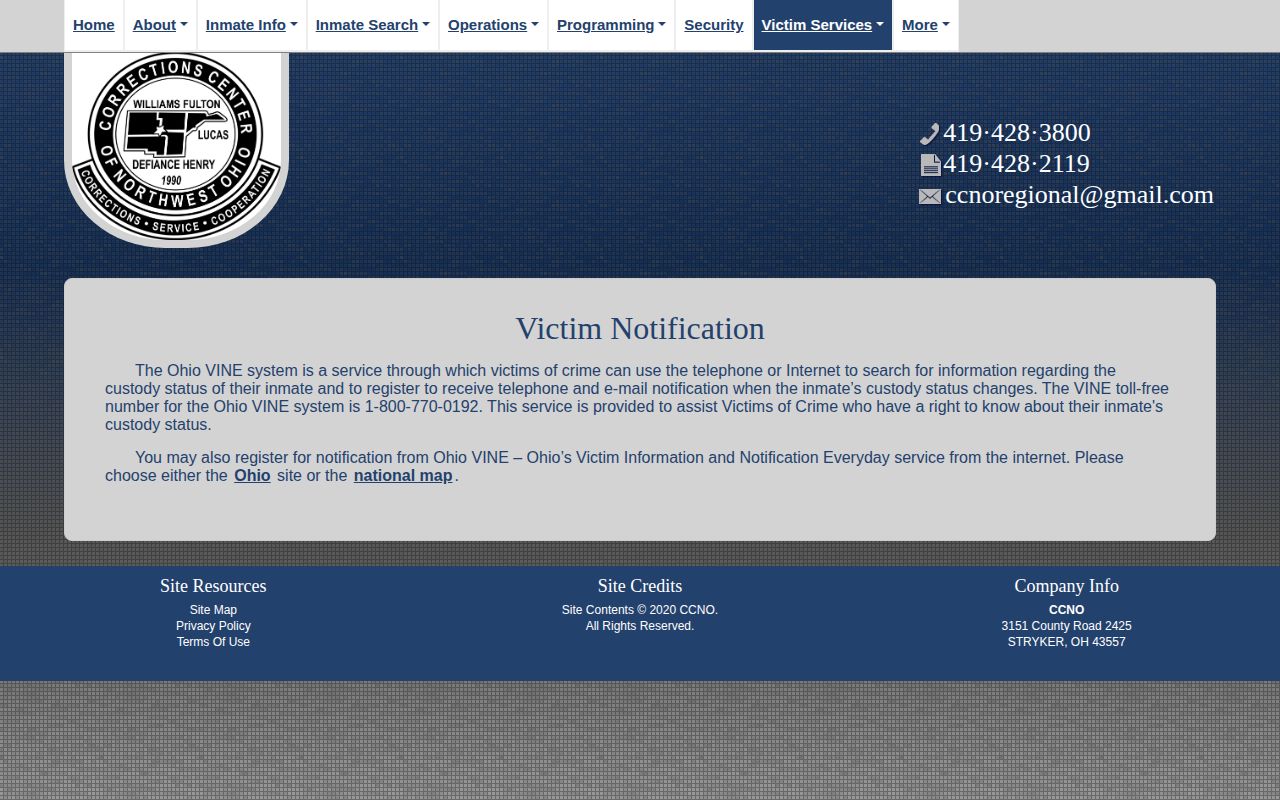
The screenshot documents CCNO's notification channel. Confirm any alert with CCNO or the new custodian, especially when the message reports a transfer.