
Federal Prison Release Scope
The Federal Bureau of Prisons operates federal correctional institutions nationwide. It does not operate a Fulton County jail or an Ohio county release feed. A Fulton-area federal case can begin with an arrest, a federal court appearance, and pretrial detention under the U.S. Marshals Service. CCNO describes a USMS contract, so a federal detainee may be physically held in Stryker while remaining in Marshals custody.
BOP becomes the key public locator for people in its prison system and for former federal prisoners within its historical coverage. The locator covers federal prisoners from 1982 to the present. A BOP release date answers when BOP custody ended according to that system. It does not describe every later legal duty or new custody event.
| Federal stage | Likely authority | Public route |
|---|---|---|
| Pretrial or transport detention | U.S. Marshals Service, often through a contract jail | Federal docket, counsel, known holding facility, or focused USMS inquiry |
| Sentenced federal imprisonment | Federal Bureau of Prisons | BOP Inmate Locator |
| After BOP release | Federal court supervision may continue | Federal docket and U.S. Probation |
| Immigration handoff | ICE Enforcement and Removal Operations | ICE Online Detainee Locator and ERO contact |
Note: A federal case row in a CCNO report does not prove that BOP has received the person.
BOP Release Lookup Steps
The BOP Inmate Locator offers two basic search routes. A register-number search is more exact when the identifier is known. A name search can use first, middle, and last name with demographic filters. Spelling, aliases, and common names can produce uncertain results, so compare every available identifier before treating the record as a match.
- Confirm from the federal docket, CCNO disposition, or another official record that BOP is the correct custody system.
- Search by BOP register number when available. Otherwise use the name and supported filters.
- Open or read the matching result and record the custody wording and release date exactly as displayed.
- Check the federal docket for sentence, release, or supervision context. A BOP date does not resolve every court obligation.
- If the CCNO disposition names USMS or ICE instead, switch to that authority's route instead of forcing a BOP match.
The official locator image below comes from the BOP search page. It shows the nationwide federal search entry point used for a Fulton-linked sentenced federal prisoner.
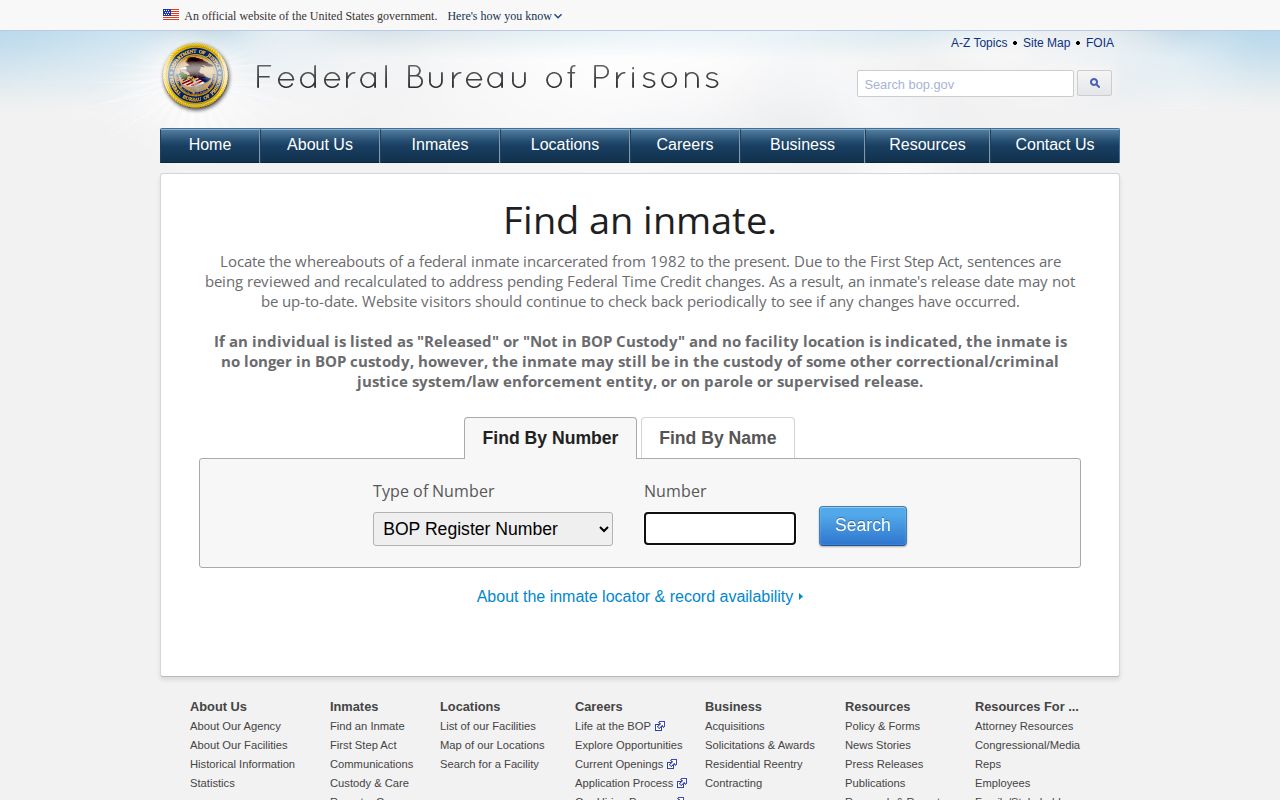
The screenshot establishes the source and search modes. It does not establish the status of a particular person, which must be checked on the live system.
BOP Release Status Meaning
A result showing Released or a release date indicates that the person is no longer in BOP custody as represented by the locator. Wording such as “Not in BOP custody” has the same key limit: BOP is only one custodian. The person could be under federal supervised release, held by USMS on another matter, detained by ICE, or in an Ohio or local facility.
Federal supervised release is ordered by the federal court and managed by U.S. Probation. It is not imprisonment by BOP. A person can therefore have a completed BOP release date and still have reporting conditions. The judgment and later federal docket entries are the official sources for that court-imposed term.
- BOP custody
- Imprisonment within the Federal Bureau of Prisons system.
- USMS custody
- Federal pretrial, transport, and related prisoner control managed by the U.S. Marshals Service.
- Supervised release
- A federal court term served in the community after imprisonment.
- Detainer
- An authority or request that may lead another agency to take custody.
CCNO Federal Release Transfers
CCNO's federal relationship creates a distinctive Fulton County search problem. Its regional reports can include federal detainees next to people held for the five member counties. A name leaving CCNO may reflect a move deeper into federal custody, a transfer to another contract site, entry into BOP after sentencing, an ICE handoff, or a true release under federal authority.
Request the CCNO booking-and-release sheet, jail-register entry, or existing disposition record for the named booking. Ask for the actual time, releasing authority, and destination to the extent recorded and public. The federal court docket can then explain the legal stage. If the entry shows delivery after conviction, search BOP after allowing for intake. If it shows continued Marshals control, the BOP locator may remain blank.
The USMS prisoner-information page explains that the Marshals control federal pretrial prisoners until acquittal or delivery after conviction and use many local, state, and private facilities. USMS does not offer a general historical public locator equivalent to BOP. A focused inquiry, the docket, counsel, and the known facility are the practical fallbacks.
Federal Prison Release Records
The public locator is the first route, not the entire federal record. A reliable confirmation set may include the BOP result, sentencing judgment, release-related docket entries, and an agency response for a specific record. The user should preserve the search date and the exact status wording because online data can later change.
Federal Bureau of Prisons
Nationwide federal prison system
Official record access: BOP Inmate Locator and BOP information channels
Use the facility shown in a current BOP record for institution-specific questions.
If the locator does not find a person who appears in a federal docket, do not infer release. The person may be pretrial under USMS, newly transferred and not yet posted, outside the locator's coverage, or entered with a different identifier. Search the court case by number where possible and contact the known holding authority. For older BOP custody, use the locator's date coverage and federal records channels.
A Fulton local arrest record and a federal record are held by different offices. The Fulton County release-record path can establish the local booking and CCNO disposition. It cannot substitute for BOP's release record. Conversely, a BOP release result does not explain the earlier local arrest or court order.
Federal Prison Release Dates
A BOP release date should be reported as the date the federal locator displays. It should not be converted into a claim about the end of all court supervision or other custody. Sentencing changes, credits, court orders, and transfers can affect a federal prison timeline, while the federal court judgment and BOP computation control the official path.
Projected dates and completed dates answer different questions. A future estimate tells when the system currently anticipates an event. A past release date is historical BOP custody information. Neither one proves what happened in another agency after that event. If the date conflicts with a docket entry, compare identifiers and request clarification from the originating federal office.
For a person first housed at CCNO, the local release timestamp may mark transfer to federal custody long before the later BOP release date. Keep both events in the chronology. Label the first as release from CCNO or transfer, and the second as release from BOP. This avoids turning one continuous custody path into a false community release.
BOP Release to ICE
An immigration detainer can produce another custody change after BOP or USMS control ends. ICE civil detention is separate from a federal criminal prison sentence. If an official record identifies an ICE handoff, use the Online Detainee Locator System. Search can use an A-number and country of birth or exact biographical data as supported by the interface.
A BOP release date followed by ICE detention is still a release from BOP, but not a return to the community. State that distinction plainly. ICE says its locator can include people currently detained or released from ICE custody within a limited recent window. A no-result outside that scope cannot disprove an older handoff.
Minors are not searchable in the same public ICE system, and spelling or transliteration can affect results. When the locator fails, use ERO's official detention contact channel and the federal docket or transfer document. The authority named in the last confirmed record always determines the next search.
Preserve the BOP register number whenever it is available. Federal names may be shared, shortened, or entered with different middle-name forms. The register number, federal case number, and CCNO booking number connect separate records without assuming similar names describe the same person. If those identifiers conflict, stop the match and verify through the originating agency.
For an older federal release, note the locator's 1982 start point. A person outside that public coverage may require a focused federal records inquiry. Ask for the existing custody or release record tied to the register number and time period. Do not ask a local Fulton office to certify a nationwide BOP event it did not create.