
Fulton Released Mugshot Records
A mugshot, also called a booking photograph, is an identification image made during booking. The Corrections Center of Northwest Ohio says booking staff may photograph and fingerprint a person for identification. The image is tied to a particular admission. It does not prove guilt, and it does not state whether that booking ended by bond, time served, transfer, dismissal, or another event.
Ohio does not impose a blanket rule requiring each agency to keep every booking image in an online gallery. When an office maintains the photograph, public access is assessed under Ohio Revised Code 149.43, any specific exemption, and a sealing or expungement order. Medical, security, protected personal, juvenile, and confidential law-enforcement information can be withheld or redacted.
A precise image request is more reliable than a surname search. Use a CCNO booking number, booking date, full name, and date of birth when known. The release record should be requested separately if the goal is to confirm that custody ended. A photograph captures identification at intake, not release status.
Find Fulton Released Inmate Mugshots
Fulton County uses several possible photo channels, but none serves every custody class. CCNO holds many Fulton commitments. The Fulton County Sheriff's Office may hold its own arrest or incident material. ODRC becomes relevant only after a state-prison admission. News images and cached commercial pages are weaker because the image source, date, and later case status may be unclear.
| Channel | Photo available? | How to use it |
|---|---|---|
| CCNO active and booking reports | No verified released-photo gallery | Use the text records to identify the exact booking, then request the image |
| CCNO public-record request | Possible, subject to law | Ask for the existing booking photograph tied to one booking |
| Fulton County Sheriff's Office | Possible if the Sheriff keeps a separate image | Make a bounded request for the Sheriff-created record |
| ODRC Offender Search | Often shows a state offender photograph | Use only for a person who entered ODRC and verify the ODRC number |
| Official court record | Usually case documents, not a standard mugshot gallery | Use the docket to confirm identity, charge posture, and disposition |
| News or commercial cache | Sometimes | Treat as unverified until the official source and date are confirmed |
VINELink is primarily a custody and notification service. A record may display identifying information, but Ohio VINE is not the durable booking-photo custodian. Use CCNO or the agency that made the image when the exact Fulton booking photograph is needed.
Note: An ODRC image identifies a state-prison record and may not be the photograph taken during the Fulton County arrest.
No Fulton Released Photo Gallery
This is Fulton's required distinctive point. CCNO's reviewed active-population and booking PDFs carry detailed text fields, including booking numbers, physical descriptors, dates, charges, status, and court information. They do not provide a verified gallery of mugshots for people released from Fulton County custody. No official Fulton, Ohio sheriff or CCNO mobile app with a released-person photo view was verified.
The absence matters because similarly named tools can be misleading. Search results for “Fulton County Sheriff app” often point to Fulton County, Georgia or another jurisdiction. An app should not be treated as an Ohio source unless the Fulton County Sheriff's Office or CCNO links to it officially. As of the research date, their official pages point to web records rather than a verified local release-photo app. The Fulton 24-Hour Releases explanation also distinguishes CCNO's previous-day booking report from an actual release feed.
CCNO's historical booking search can help locate an older booking number by name and booking-date range. Results expose core booking identifiers before a detail opens. The research did not verify that the history result displays the actual release time, release type, or a released-person photo archive. Use it to identify the booking, then request the image and release entry.
Request Fulton Booking Photographs
The CCNO Public Records Requests page is the direct path for a regional-jail photograph. Ask for an existing electronic image, not a new compilation or an explanation. If a Fulton law-enforcement agency created a distinct arrest photograph, send a separate bounded request to that agency.
- Identify one booking. Give the full name, date of birth if known, CCNO booking number, and a narrow admission-date range.
- Name the record. Request the existing booking photograph associated with that booking. Ask separately for the booking-and-release sheet when release proof is also needed.
- Select a channel. Email ccnoregional@gmail.com, mail Public Records Request, CCNO, 03151 County Road 2425, Stryker, OH 43557, visit during listed business contact hours, or call 419-428-3800 extension 201.
- Prefer an electronic copy. Ask whether the stored image can be sent electronically and request a cost estimate if a charge may apply.
- Review any redaction. If all or part is withheld, ask for the legal authority and the segregable public portion.
CCNO lists business contact hours as Monday through Friday from 8 a.m. to 4 p.m. Its page lists single-sided letter-size paper copies at twenty-five cents per page and says copies are provided at cost within a reasonable time. That paper rate does not establish the price of an electronic photograph. Ask the custodian.
ORC 149.43 calls for prompt inspection and copies in a reasonable period, not one universal deadline. The office need not create a photograph it does not keep. Confidential investigatory details, protected identities, security-sensitive facts, and other barred content may be withheld. A narrow request reduces mistaken identity and review burden.
The official request screen below shows the durable CCNO channel. Open the source used for Fulton booking-photo requests.
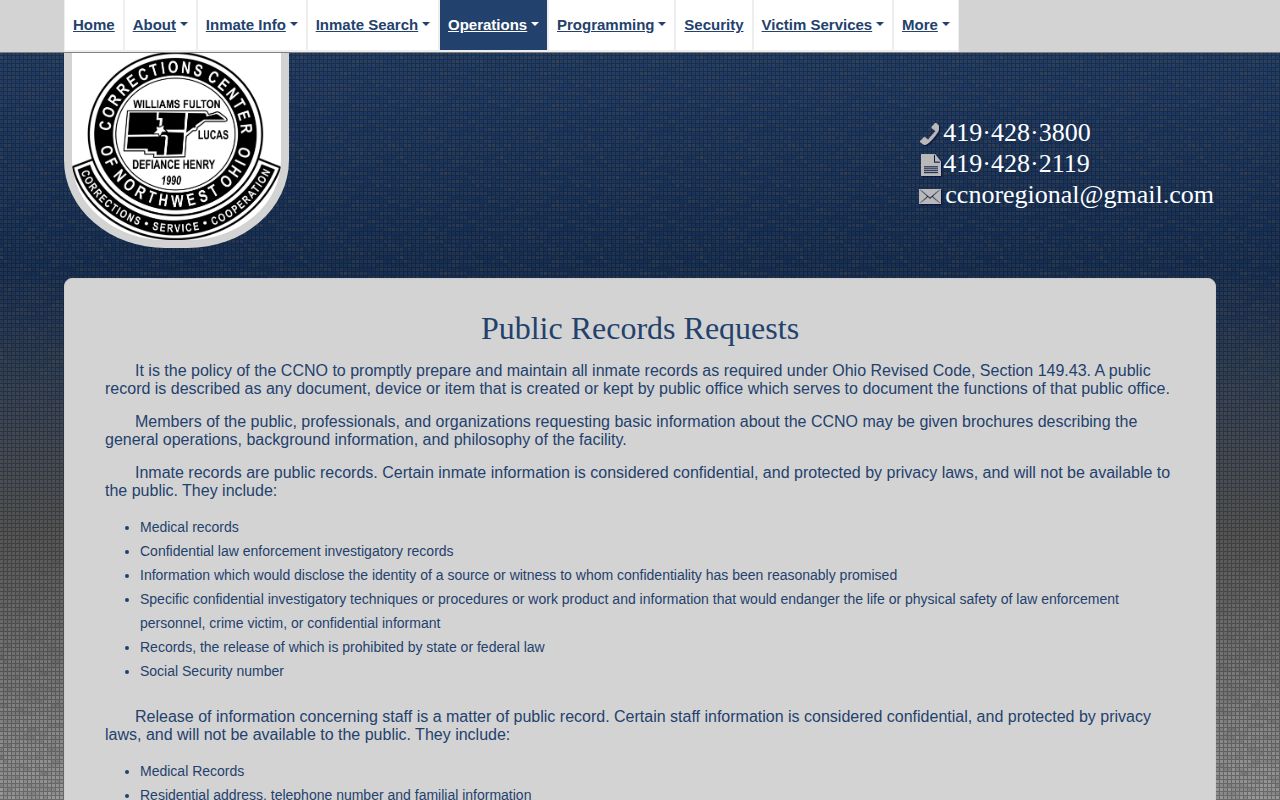
The records office, not the screen image, decides whether the identified photograph is maintained and releasable.
ODRC Photos After Fulton Release
A person sentenced from Fulton Common Pleas may leave CCNO through a prison conveyance. That movement is not a community release. After ODRC reception and data entry, the ODRC Offender Search may show the offender's photograph, number, aliases, institution or supervision status, offenses, sentence rows, and release-related fields.
Match the ODRC number, sentencing county, case, and identifiers. A photo resemblance is not enough. ODRC name searches can be broad, and historical plus current sentences may appear together. County of Commitment means the sentencing county, not the current home county.
The state image belongs to the ODRC record. It may have been taken at reception or updated later. It should not be labeled as the Fulton arrest photo unless the source confirms that. A person who served only a local CCNO term may never have an ODRC photo.
Verify Fulton Mugshot Context
A photo without its booking and disposition can create the wrong impression. Use the CCNO booking number to find the related confinement record. Then check the appropriate Fulton court case. Common Pleas handles felony cases. Eastern and Western District Courts handle misdemeanor cases in their territories.
Useful docket entries include bond posted, recognizance, dismissal, sentencing, jail-time credit, community control, conveyance to ODRC, judicial release, termination, violation, and sealing. A “case closed” label does not state the exact moment physical custody ended. The signed entry supplies legal authority, while the CCNO release record supplies the completed custody event.
The official county portal warns that court action and online posting can lag. A photograph should therefore be dated and described by its source, not treated as a live account of custody. For a recent named-person search, the Fulton release-record process shows how to compare the regional jail, court, state, and federal paths.
Fulton Mugshots Beyond Official Records
Commercial databases, search caches, and news reports can display an image after the official roster changes. Those channels are secondary. A cached page may carry stale custody language. A common name can be mismatched. Some pages may omit a dismissal, transfer, later sealing order, or the fact that the displayed image came from a different agency.
Local reporting is episodic. A news image can be a booking photograph, ODRC image, courtroom photograph, or supplied headshot. Confirm the caption and named source before calling it a mugshot. No commercial mugshot publisher or removal service is endorsed as a verification channel.
Use the government-held image when provenance matters. If an unofficial copy conflicts with an official record, preserve the official source date and contact the publisher through its stated correction process. Do not use a stale mirror to reconstruct information that a court has lawfully restricted.
Ohio Mugshot Removal and Sealing
Ohio's sealing and expungement rules appear in ORC Chapter 2953. Eligibility, timing, and the effect of an order vary by outcome, offense, and record type. Current forms are available from the Supreme Court of Ohio. Once access is restricted by a valid order, do not bypass it with an old cache.
ORC 2927.22 is Ohio's targeted anti-pay-to-remove law. It covers criminal-record information and expressly includes booking photographs. The statute bars negligently soliciting or accepting a fee from the subject to remove, correct, modify, or refrain from publishing that information. It creates criminal and civil consequences.
The law is not a blanket ban on government disclosure. It also does not command every office to place mugshots online. Agency access still turns on ORC 149.43, applicable exemptions, and any sealing or expungement order. Ask the agency and court for the current official status rather than paying for a promise that may not affect other copies.
Public Record Search
Sponsored Results